1. Find a paragliding school: location, quality, budget
Location of the school
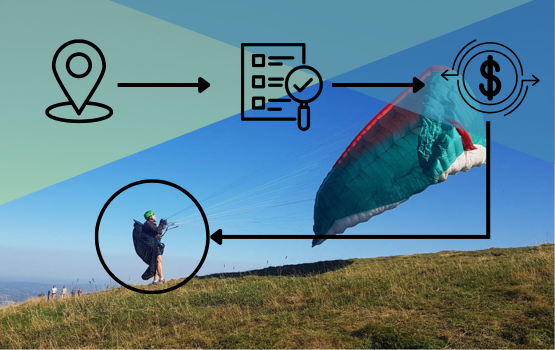
Finding a paragliding school that fits your geographical situation and expectations is the first crucial step. You will need to choose between a school close to your home or near a well-known flying site, which will make course logistics easier, or taking a full week to discover a new area with ideal conditions for beginners.
Many schools are located in mountainous regions such as the Alps, the Pyrenees, or near popular spots like Saint-André-les-Alpes, Vallouise, Mévouillon, Chamonix-Mont-Blanc… Which offer ideal flying conditions for beginners.
Pro tips : Choose a school with no more than 7 students per instructor to ensure a personalised and high-quality training experience. Also check that the equipment is recent and that you will keep the same set (wing and harness) throughout the week for both ground handling sessions and first high flights.
Quality of the school
A high-quality school is not necessarily certified by the FFVL (French Free Flight Federation). However, it is essential that the instructors are fully qualified. A good school will prioritise safety while offering courses adapted to your level, with personalised guidance.
Budget
Prices vary from one school to another depending on the duration of the courses, the equipment provided, and the location. For a 5-day introductory course, expect a budget between €650 and €800. This price includes the flying equipment (wing, harness, reserve parachute, helmet, radio, etc.), supervision by qualified instructors, and transport to the flying sites.
2. How a paragliding initiation course works
A paragliding initiation course generally lasts 5 days and is specifically designed to help you acquire both technical and theoretical skills. It is a progressive learning process that prepares you to become a competent paragliding pilot, while providing a solid foundation for your future practice.
Theory and the basics
At the beginning of the course, you will cover theoretical knowledge, which is essential for understanding the mechanisms behind each manoeuvre.
You will learn the fundamental principles of paragliding flight, such as flight mechanics, basic piloting, and the different phases of a flight (takeoff, flight plan, and landing). You will also be introduced to the basics of weather forecasting, a crucial aspect for interpreting flying conditions. This theoretical component is essential for understanding the concepts that underpin practical skills.
Ground handling practice and first flights
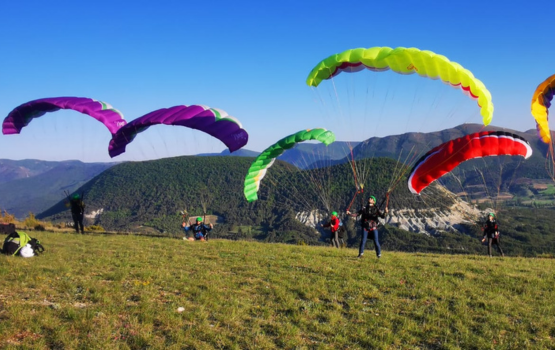
The first days of your course will be mainly dedicated to ground handling. You will practice inflating the wing and learn how to control it while staying on the ground. These exercises, usually done in a field, are designed to familiarise you with the movements needed for successful takeoff and landing.
Learning to control your wing on the ground is an essential step before you can fly safely. This phase will help you gain confidence and develop the skills needed to move on to the next stage: your first flight.
Solo flights and first landings
Once you have mastered ground handling and wing control, you will be ready for your first solo flights. This usually happens around the 3rd or 4th day of the course, once you feel comfortable with the ground exercises.
During these first flights, you will be guided by an instructor using a radio system. One instructor will accompany you during takeoff, while another will guide you throughout the flight and landing. These initial flights take place in controlled conditions, with the goal of giving you a safe and enjoyable first flying experience.
3. Getting equipped for paragliding
Once you have completed your initiation course and acquired the necessary basics, it’s time to think about purchasing your own equipment. Although it’s not immediately required, having your own gear allows you to progress more quickly and practice under more consistent conditions.
Buying new or second-hand equipment?
Buying new equipment is an option, but it can be a significant investment, especially for beginners.
If your budget is limited, it is perfectly possible to find high-quality second-hand equipment. Many paragliding schools offer used gear after initiation courses, which can be an excellent way to start without spending too much.
The advantage of second-hand gear is that you can get good-quality equipment at a lower price, but it is crucial to check its overall condition. The equipment must be in good shape and have been inspected by a certified workshop. A reliable seller, whether a school or a private individual, should be able to provide an official inspection report for the wing and ensure that all components have been properly checked.
Essentials elements of equipment
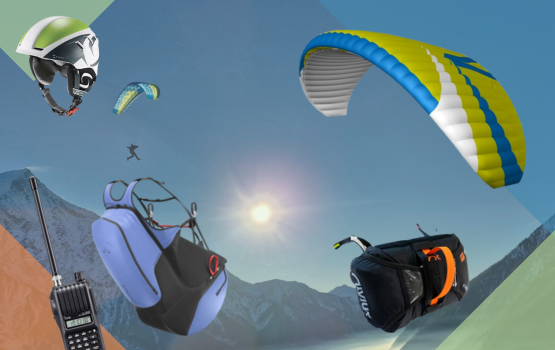
Paragliding equipment consists of several key items essential for your safety and comfort in flight. Here are the main components:
- The paraglider: This is the wing itself, the central element of your equipment. Choose a wing suited to your weight and level of experience. Category A wings are designed for beginners and are easier to control.
- The harness: This is the seat in which you are suspended during flight. It should be comfortable and properly adjusted to your body.
- The reserve parachute: Essential for your safety in case of an emergency, it must be correctly maintained and repacked regularly.
- The helmet: Safety is paramount in paragliding, so a helmet is essential to protect your head in case of an accident.
- The radio: The radio allows you to communicate with your instructor or other pilots during flight. It is an important safety device.
Choosing your paragliding equipment
We have a detailed article on choosing paragliding equipment, which provides additional information to help you make the right decisions based on your level and needs.
Keep in mind that investing in quality equipment, whether new or second-hand, is essential for progressing safely and confidently. It is always best to choose gear that is recent and well-maintained.
--- How to choose the right paragliding equipment for beginners ---
4. Continuing your training: progression courses or supervised flights
After completing an initiation course, it is crucial to continue your learning to master more advanced paragliding techniques. Paragliding is a sport where experience builds gradually, and it is important to keep training to improve your skills.
There are several ways to progress, including progression courses and supervised flights. Here is an overview of the two options available.
Progression course
Progression courses are designed for pilots who have already completed an initiation course. These trainings aim to deepen the basic skills acquired during the initial learning phase and guide you toward autonomy.
The goal is to gradually enable you to fly independently, although the actual level of autonomy varies depending on the pilot.
Typically, about thirty supervised flights are needed to reach a certain level of independence, but this number can fluctuate depending on flight frequency, experience gained, and each pilot’s adaptability. The progression course is therefore a crucial step to consolidate your skills and prepare you to fly safely without an instructor.
Supervised flights
If you prefer a more flexible approach, supervised flights are an ideal alternative. This option allows you to fly under the supervision of an experienced instructor who will guide you during your flights, offering real-time advice to improve your technique.
Unlike more structured progression courses, which typically last around 5 days, supervised flights can be scheduled more sporadically, making them a convenient solution for those with tighter schedules, such as pilots who can only fly on weekends.
Supervised flights are perfect for pilots who want to continue practicing regularly while receiving constant feedback on their flying, without committing to a long-term training program. This allows for continuous progression while adapting to your own pace and availability.
A bit of reading…
In addition to practical training, there are written resources that can help you deepen your understanding of paragliding and refine your skills. Among the most recommended books, "Le manuel du vol libre" is a comprehensive classic that covers all aspects of paragliding, from fundamental basics to advanced techniques. This book is an essential reference for enthusiasts and pilots in training. This book probably exists in English, if you want to look for it.
5. Approach a paragliding club
Joining a paragliding club is an excellent way to continue progressing after your first courses. Not only will it allow you to fly regularly, but it will also give you the chance to meet more experienced pilots, with whom you can exchange tips and advice. Clubs often organize outings where you can benefit from the experience of other pilots.
Guided outings led by certified instructors are particularly valuable for beginners, as they allow you to fly under the supervision of experienced pilots while receiving personalized guidance. By getting involved with a club, you’ll also have the opportunity to share your experiences with fellow enthusiasts.
This creates a collective learning dynamic that can be very rewarding.
BONUS – Tips to Help You Progress:
After your progression course and your first supervised flights, it is highly recommended to obtain your Brevet Initial (initial certification) before flying independently. Once you have this certification, your instructors will consider you capable of flying solo on familiar sites under calm conditions.
Here are some tips to continue your progression:
Practicing Groundhandling
Groundhandling is a fundamental skill to master. It’s one of the basics of paragliding, and regular practice is essential. The more you practice groundhandling, the more precise and responsive you will become, which makes a big difference during take-offs.
Practice groundhandling in different wind conditions, starting with light breezes and gradually moving to stronger winds. Focus on your movements and sensations, and treat each inflation session as a learning opportunity. It’s an excellent way to better understand your wing’s behavior and adapt to different situations.
Make these sessions a kind of “playtime,” where you can try different exercises and test your limits. There are also many Ground Handling videos on YouTube that can inspire you and give you ideas for new exercises. You will likely enjoy it, and it becomes a fun and effective way to improve your skills.
Quick reminder: Don’t forget your helmet during these sessions, as groundhandling can sometimes bring surprises!
Video Debriefing
A very valuable tool for improving is video debriefing. Don’t hesitate to ask to be filmed during your flights or inflation exercises. This allows you to analyze your movements and identify areas for improvement. You can then send these videos to your instructors for personalized advice. Instructors are usually eager to follow your progress and help correct the small mistakes that often go unnoticed in the moment.
Flying in Calm Air on Familiar Sites
When you start flying independently, it’s essential to choose times when the air is calm. Ideally, select simple weather conditions, such as an anticyclonic day with little wind, and favor morning hours before thermals develop. These ideal conditions allow you to fully concentrate on your technical skills without having to deal with turbulence or sudden changes in weather.
Perfecting Take-Offs and Landings
Take-offs and landings are the two most important phases of a paragliding flight. These critical moments should be practiced repeatedly to gain fluidity and confidence. The more you repeat these steps, the more comfortable you will become, and the better you will be able to handle each situation calmly and effectively. Repeating these movements is how you develop your skills and your ability to analyze each flight.