The different practices of paragliding
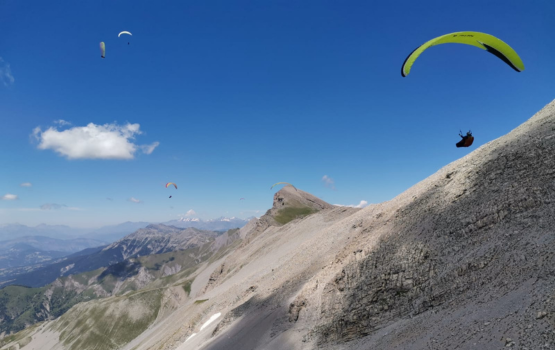
Site flying is often the starting point for most pilots, but for many, it also remains their primary form of flying throughout their lives. Pilots take off from a familiar site, with known landmarks, an established landing area, and well-understood local aerological patterns. It is a reassuring environment, yet far from monotonous.
The same site can offer completely different experiences depending on the time of day, the season, or the weather conditions. A calm morning flight, stronger and more demanding midday thermals, or the gentle evening glass-off each provide unique sensations and challenges. By flying regularly at the same location, pilots learn to anticipate conditions, observe weather cycles, and continuously refine their skills. It becomes a valuable school of patience, observation, and steady progression.
Site flying also allows pilots to fly frequently without complex logistics, simply for the pleasure of being in the air. It is where strong foundations are built, foundations that will later support every other aspect of paragliding practice
Hike & Fly
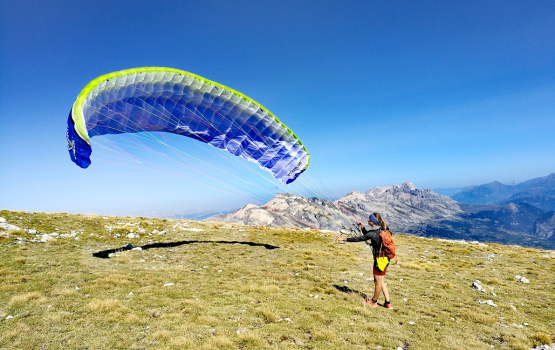
Hike & fly completely changes the relationship between the pilot and paragliding. Here, the flight begins long before takeoff. The adventure starts on foot, sometimes after a long climb with the wing on your back, while observing the sky, the wind, and the evolution of the clouds. Every step brings you closer not only to takeoff, but also to an important decision.
Hike & fly requires genuine self-reliance. Pilots must be prepared to turn back if conditions are not suitable, even after several hours of ascent. And when flying is possible, the experience is often simple, pure, and direct. You launch from a summit and glide effortlessly back down to the valley, avoiding hours of descent on foot and sparing your joints in the process.
Beyond the flight itself, hike & fly offers a unique connection with the mountains. The effort of the climb gives greater value to the flight, and the reward is not measured in airtime alone. It is an activity that combines physical effort, careful observation, decision-making, and the incomparable feeling of leaving the ground from a place reached entirely under your own power.
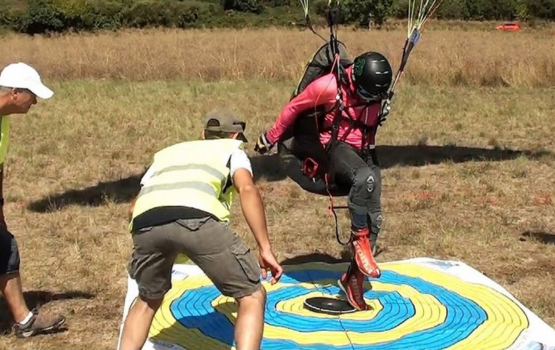
Landing precision is sometimes seen as a separate discipline, reserved for competition. In reality, it concerns all pilots. Being able to land exactly where you want, whatever the conditions, is an essential paragliding skill.
Working on precision requires paying attention to every detail of the approach. The choice of plan, height management, analysis of aerology close to the ground, etc. Nothing is left to chance. In competition, the world's best pilots are able to place their foot a few centimeters from zero, with impressive regularity.
Pilots like Laurent Peltier or Jérôme Demay have left their mark on this discipline with their consistency and mastery. But beyond the podiums, landing precision contributes enormously to everyday piloting. It develops calm, lucidity and the ability to adapt, valuable qualities, especially when you have to navigate difficult or unexpected terrain.
Distance flying, cross country
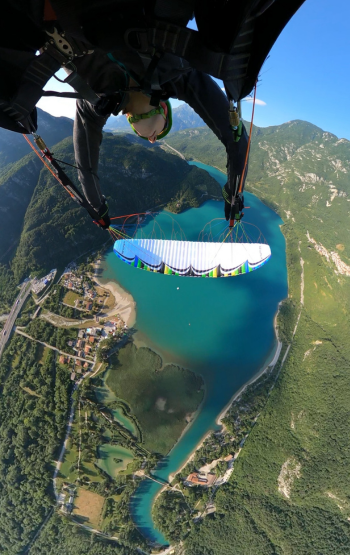
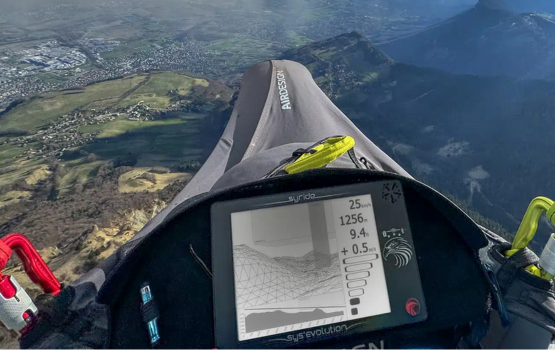
Distance flying is often a turning point in a pilot’s life. We no longer just seek to stay in the air, but to go somewhere. Each cross is an adventure, with an element of preparation, uncertainty and improvisation.
Before even taking off, you have to analyze the weather, understand thermal cycles, and imagine a possible route. In the air, everything can change. An uplift that does not trigger, a ceiling that drops, a choice to make between continuing or ensuring a more buoyant zone. Cross country is a school of humility (and frustration). Even the best sometimes miss distance flights
Acrobatic flying is undoubtedly the most impressive discipline of paragliding. Here, the pilot no longer seeks finesse or distance, but uses the energy of the sail to perform a series of figures. It’s three-dimensional piloting, where precision is absolute.
This practice has seen the emergence of real paragliding figures, such as Horacio Llorens, multiple world champion, Raúl Rodríguez, Pal Takáts and Théo Deblic. They marked the history of acro with spectacular sequences and unique figures, constantly pushing the limits of what it is possible to do under a sail.
Acrobatic flying requires a certain commitment. The training is long, progressive, the equipment specific and the mental preparation essential. Behind the spectacular side, it is a very rigorous discipline, where each gesture is anticipated and controlled. The margin of error is small, which requires great humility.
Acro flying goes through several stages but repetition is essential to progress. The first figures are worked above a body of water with boat safety to be repeated until mastery and thus continue the work above the "hard".